On occasion you will teach a course and have a student withdraw
from it. This is not a big deal since
there could be many reasons for this happening.
However, when the Dean needs you to report the students grades from work
prior to the withdrawal, it then becomes a big deal. How can you view their grades and participation
when this happens?
Luckily, in Brightspace, viewing the grades from a student
who has withdrawn from the class is no big deal.
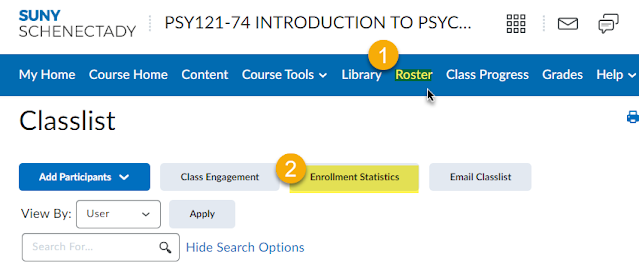
There are four simple steps:
From inside your class, select the Roster option.Fortunately, at SUNY Schenectady, that is
right on the menu. (The Roster can also be found in the Course Admin under
Course Tools.)
Select the Enrollment Statistics button
Scroll down to the bottom and a list of
withdrawn students is displayed.
Click the chevron next to the student in
question to view their information.
Please note that you will need grade items for grades. Likewise, the attendance
is from the Brightspace Attendance feature. Your college may use a different
system for tracking.
These four easy steps will give you access to their grades
and information.
Since the Lockdown the use of videoconferencing can no
longer be denied as a key part of online education. Whether you are teaching a synchronous
course, a hybrid, holding virtual office hours, or providing a sense of
community with an optional introduction in an asynchronous session, you will
need to select a video conferencing tool the suits your needs. But which one?
Collaborate in Blackboard and Bongos Virtual Classroom in
Brightspace are free and are conveniently embedded inside the LMS. However, not
everything that is free, such as the flu, is good. Both of these free
applications refuse to provide automatic captioning. They do ‘claim’ to have captions provided you
arrange for a transcriptionist to transcribe them in real-time. Free and not
toxic at all!
But why should I care if I do not have any deaf students? First, in many cases you are not aware of all
of your students’ disabilities. One in ten college students report having a
disability and this should not be ignored.
Second, The American Disabilities Act
requires organizations to provide accessible online content and missing
captions is frequently cited in ADA lawsuits. Don’t be that guy - meet WCAG standards.
Captions expand your audience and increase their engagement often in unexpected
ways. In 2022 50% of US
citizens surveyed stated they use captions ‘most of the time’. The study also revealed that 70% of members
of Gen Z (ages 11-25) frequently use subtitles. They are a growing demographic
of students, and they will expect captioning.
Luckily, you can easily provide captioning in video conferences by using MS
Teams. When you enter a meeting, you
merely select the “more’ feature on the menu – its symbol is three dots. Go to “Language and Speech” and select “Turn
On Live Captions”. Now you have live captions. You could also do this by
selecting “Accessibility” and turning on the Captioning tab. This is an individual feature, so all your
students can access it and use it privately.
A similar feature exists in Zoom.
Live captioning also helps you be more inclusive by
assisting ELL students or offering translations for non-English speakers. MS Teams, as well as Zoom
(with the Wordly App add-on), not only offer real-time captioning, but language
translation. Once the captioning is on
in Teams, select the three dots on the top right corner of the captions
bar. This will offer the following
options:
1.Change
the spoken language. This is handy
when your class is not in English.
2.Translate
the captioning language. Yes, this feature can translate your session into
more than 30 languages. This helps level the bar for ELL students who may have
difficulty understanding their second or third language in the online
environment.
The translation tool is not as good as an interpreter. For
example, ‘Warming the cockles of your heart’ does not mean to “heating the
mollusks inside your cardiac organ”. However, the translation feature is a
handy tool when you need something. It is effectively an electronic dictionary/translator
to assist your students.
Remember, not all instructional technology is the same, and
this definitely applies to video conferencing applications. Choose one that has auto-captioning and
translations. It is not only more
inclusive and accessible but demonstrates your commitment to being so.
Amin, F. M., & Sundari, H. (2020). EFL students’
preferences on digital platforms during emergency remote teaching: Video
conference, LMS, or messenger application? Studies in English Language and
Education, 7(2), 362-378.
Patil S & Davies P. (2014) Use of Google
Translate in medical communication: evaluation of accuracy BMJ 2014; 349:
g 7392 doi:10.1136/bmj.g7392
Kaliyadan F, & Gopinath Pillai S. (2010)The use of google language tools as
an interpretation aid in cross-cultural doctor-patient interaction: a pilot
study. Inform Prim Care 18:141-3.
Frequently faculty resistant to inclusive teaching pose the
following retort:
As much as they want to promote
equity and inclusion in their classroom, they cannot adopt many principles
because their course must be rigorous.
Let’s unpack this claim and consider what is meant by
“rigor”? Often this term is vague and
does not describe what type of learning environment we want (Clark &
Talbert, 2021). As such, invoking ‘rigor’ as an excuse to not adopt inclusive
teaching practices is either a conscious or unconscious case of sophistry. Often there is a bifurcation in meaning of
‘rigor” where it can either mean:
Intellectual
rigor; that challenges students to explore and master complex content and
hone their knowledge through critical reflection.
Logistical
rigor; that demands adherence to inflexible polices about when and how work
or behavior is to be evaluated.
Courses could have either, neither, or both.
Intellectual rigor directly relates to students meeting the
course’s intended learning outcomes. It
is not a plethora of busy-work, but purposeful and transparent. Intellectually rigorous
courses push students to learn. This can be done without excessive work, but
instead with carefully aligning learning activities and assignments to expected
learning outcomes.
In contrast, courses with logistical rigor have
strict policies about when and how the student is to be evaluated. These
inflexible rules are often short-hands for contributing to a wider grade
distribution. However, grading based solely on students’ weight can likewise create
a wide grade distribution (Syphers, 2021).
This does not ensure intellectual rigor or students learning the course
content. In fact, it can frustrate
learning and help create inequitable barriers. If these barriers have no
relationship with the learning outcomes, are they necessary? Should we penalize ELL students taking
calculus because they do not have a master modus auxiliaries and pluperfect
tense in English? Why?
Logistical rigor can lead to infantilizing students by
creating arbitrary barriers based on the faculty’s mistrust in them. This ‘toxic” rigor assumes that students not
meeting the logistical demanded are lazy and not to be trusted. This adversarial attitude has never been
demonstrated to improve learning outcomes, but does disproportionately hurt
certain at-risk groups (Pryal, 2022). Toxic rigor sets up obstacles for
students and frustrates their success while then criticizing their character
for failing to meet these arbitrary barriers. However, this position tends to
promote antipathy for students instead of empathy and the desire to guide them.
Shouldn’t we believe in our students instead of doubting we should believe
them?
The thing that's really sticking out to me in my research and reading on "rigor" is that so much the rigor discourse is uncomfortably close to the language abusers use to justify themselves to their victims.
It seems that the appeal for ‘rigor’ is more often an excuse
for not changing teaching practices without evidence or in spite of evidence
that adopting inclusive teaching practices would improve academic
performance. Providing scaffolds to assist student learning has been a best
practice is pedogeological theories, such as Universal Design for Learning. Assisting
students in successfully meeting learning outcomes isn’t undermining academic
integrity. It is just good teaching.
In short, we can retain our academic standards and care
about our students at the same time.
Adopting inclusive teaching practices is indeed compatible with
intellectual rigor. In the end, since
this is the version of rigor that cares about learning it is the only type of
rigor educators should care about.
Principle of Engagement - Guideline 1 - Criterion 2
When developing a course using the third principle of Universal Design for Learning, there are three specific guidelines to assist us. The first, Recruiting Interest, focuses on how accessible the content is to learners. Information that does not engage the learner’s cognition is effectively inaccessible.
Criterion 2 of this guideline advocates that we optimize relevance, value, and authenticity
of what is learned.
Learners are more likely
to be engaged the content if they find it meaningful or relevant. This is
not just a good idea for instructors to consider, but best practices in adult
education. This also accurately applies to the largest growing group of college
students, non-traditional learners. When the activities are relevant and
authentic to the learner’s individual goals and interest, the learner is more
likely to focus more energy on the content and stimulate the learning
process. People are rarely interested in information that has no
meaningful connection to their lives.
To be a more effective
educator, you should demonstrate the relevance of the content through authentic
activities. These can be role-play or based on fiction, but in some way
have a connection to the students personally. To assist this process,
try offering options that optimize what is relevant, or valuable, to the
learner. Letting the learner self-select the option promotes the
sensation of autonomy and allows learners to select the option that they
perceive as more meaningful.
Some tips for assisting
connecting learning to experiences in meaningful ways to the learner include:
Fluctuate activities and sources of information
so that they can be:
Age and ability appropriate
Personalized and contextualized to learners’
lives
Culturally and socially relevant and responsive
Appropriate for different racial, cultural,
ethnic, and gender groups
Design activities so that learning outcomes are
authentic, communicate to real audiences, and reflect a purpose that is clear
to the participants
Encourage personal response (while being
professional and focusing on the course), evaluation and self-reflection to
content and activities
Promote active learning with tasks that allow
for active participation, exploration, and experimentation
Include activities that foster imagination to
solve novel and relevant problems, or make sense of complex ideas creatively
By following these suggestions, your course will assist students in communicating and expressing their knowledge, as well as being in line with the Principle of Engagement in the Theory of Universal Design for Learning.
Principle of Engagement - Guideline 1 - Criterion 1
When developing a course using the third principle of Universal Design for Learning, there are three specific guidelines to assist us. The first, Recruiting Interest, focuses on how accessible the content is to learners. Information that does not engage the leaner’s cognition is effectively inaccessible.
Criterion 1 of this guideline advocates that we optimize individual choice and autonomy.
One of Wlodkowski’s (1993) key findings about adult learners is that they prefer to direct their own learning. Most everybody prefers to have some control over what they do. Offering autonomy to students gives them a sense of agency that inspires learners.
While some aspects of the course may be static, such as the learning objectives, how one can achieve those objectives is not. There can be many different ways to demonstrate achieving an objective and through many different tools of mediums.
Offering learners a choice promotes a sense of agency where the learner ‘owns’ their accomplishment by:
·Taking pride in their
accomplishment ·Developing self-determination
·Increasing the connectedness to
the content.
Offering autonomy helps empower learners to take charge of their own learning.
Because of variation, learners will differ in the degree of the kind of choices they prefer. To better meet every learner's needs, learners should also have the choice in the level of independence in each environment. A few things to consider when promoting autonomy include:
Promoting as much autonomy, and
discretion, as possible by offering choices in such things as:
The level of perceived challenge
The type of available rewards
The tools available for information gathering
The content used for practicing and assessing skills
The color, design, or other graphical considerations
Allow learners to participate in the design of academic tasks.
Give the options so they feel in control of their learning
Involve learners, where and whenever possible, in setting their
own personal academic and behavioral goals
By following these suggestions, your course will assist students in communicating and expressing their knowledge, as well as being in line the Principle of Engagement in the Theory of Universal Design for Learning.
References
Wlodkowski, R. J. (1993). Enhancing adult motivation to learn. San Francisco, CA: Jossey-Bass.
Principle of Engagement - Guideline 1 - Recruiting Interest
The first principle of Universal Design for Learning, ‘provide multiple means of engagement”, helps promote an inclusive learning environment on many levels.When developing a course and focusing on this principle, there are three guidelines to follow. They are:
Recruiting
Interest
Sustaining
Effort and Persistence
Self-Regulation
We are
now going to take a deeper look.
The first guideline, Recruiting Interest, again
is related to accessibility. This time it is a different kind of
accessibility. Information that does not engage the learner’s cognition is
effectively inaccessible. From the moment if passes by the student, if
the student does not process the information as relevant, the information
passes them by unprocessed, or unnoticed. After this point, instructors
will have to devote more energy to stimulate the learner’s engagement with the
material or getting the learner’s attention.
For Example: Recruiting interest is just like marketing a good product. You could have the best
product on the market. If customers are not aware of the benefits of
owning your product, or even that your product exists, then they will not
purchase your product. After they pass it by, more energy will be needed,
such as commercial advertising, to get the consumers interest in your product
that they currently do not recognize as an item that serves any purpose for
them. Just like a product, the information to be learned must have a reason for
the learners to engage with it.
Likewise, when teaching, learners need to know why the
information is important and that they should be engaged in it. The problem is
that not every learner is the same. They can differ significantly.
Even the same learner can differ over time or circumstance, such as their
interests change as they learn more. Thus, it is important to have
several alternate techniques to recruit learner interest. We can become
more inclusive by ensuring that these techniques are able to accommodate the
variety of differences among learners.
Some criteria to help meet this guideline include:
Optimize
individual choice and autonomy. Adult learners prefer to direct their own learning.
Optimize relevance, value, and authenticity. Learners are more likely to engage the
content if they find it meaningful or relevant.
Minimize threats and distractions
By promoting an
inclusive strategy with multiple ways of recruiting interest in a wide variety
of learners, your learning environment will be more accommodating and promote
student success.
Principle of Action and Expression - Guideline 3 - Criterion 4
When developing a course using the second principle of Universal Design for Learning, there
are three specific guidelines to assist us.
The third, Executive Function, allows us to take advantage of our environment and overcome short term reactions to reach our long term goals.
Criterion 4 of this guideline advocates that we enhance the learners’ capacity for
monitoring progress.
Feedback is
essential for learning, whether we are a student learning in a classroom or an
educator assessing their course.
Naturally, learners require a clear understanding of their progress, or
lack thereof. When assessments and feedback are not informative to the learner
or are not timely with the feedback, there is not sufficient time for learning
to take place. Students do not know what they need to do differently and do not have time to adapt. This lack of knowledge, may give the illusion
that students are careless or unmotivated, but it is a result of the learner
not having access to appropriate feedback and time to utilize it. This is in part, why Chickering and Gamson’s 4th Principle of Good
Practice in Undergraduate Education calls for prompt feedback.
Without the
communication, there is no learning. It is important to provide formative
feedback that allows learners to effectively monitor their progress guide their
own practices.
A few examples of techniques to meet this criterion include:
Promote self-monitoring and reflection. You can do this by asking reflective questions.
Show representations of progress. Often visual representations accompanying these markers assist students understanding.
Provide differentiated models of self-assessment strategies such as peer-reviews and self-tests
Ask learners to identify the type of feedback or advice they prefer.
Multiple examples of annotated work or
performance as exemplars or illustrations of what not to do.
By following these suggestions, your course will assist
students communicating and expressing their knowledge, as well as being in line
with the Principle of Action and Expression in the Theory of Universal Design
for Learning.
Principle of Action and Expression - Guideline 3 - Criterion 3
When developing a course using the second principle of Universal Design for Learning, there
are three specific guidelines to assist us.
The third, Executive Function, allows us to take advantage of our environment and overcome short term reactions to reach our long term goals.
Criterion 3 of this guideline advocates that we facilitate information and resource
management.
Working
memory limits executive function. The
ability to access information during comprehension and problem-solving is
limited for all of us and it placesmore cognitive load for those new to
the information or those with certain cognitive disabilities. While chunking content can help, there are other ways we can
assist learning as well. Those new to
course material may be disorganized, absent minded, or appear unprepared. Whenever working memory is being taxed, and
naturally it is not a construct of the lesson itself, it is vital to offer a
variety of internal scaffolds and organizational aids to assist students in
organizing the information. These are
the exact same organization tools that executives use, so their adoption both
assists learning and develops tertiary skills that will further benefit the
learner.
Some things
you should consider when meeting this criterion are:
Supplying graphic organizers or templates for data collection and organizing information
Prompting for categorizing and systematizing the information
Providing checklists and guides for note-taking
By following these suggestions, your course will assist
students communicating and expressing their knowledge, as well as being in line
with the Principle of Action and Expression in the Theory of Universal Design
for Learning.
Principle of Action and Expression - Guideline 3 - Criterion 2
When developing a course using the second principle of Universal Design for Learning, there
are three specific guidelines to assist us.
The third, Executive Function, allows us to take advantage of our environment and overcome short term reactions to reach our long term goals.
Criterion 2 of this guideline advocates that we support planning and strategy development.
After setting
a goal, skilled problem-solvers plan a strategy for reaching that goal. Adult
learners in new domains, or learners with factors that impede executive
functions in any domain, often skip strategic planning necessary to complete
tasks. Instead, they inefficiently jump
right to a trial and error phase. Offering a variety of options, such as
reflection points or graduated scaffolds that encourage implementing
strategies, greatly assists learners. It can also lead them on the path of
becoming talented mentors, when they share these strategies with others.
Some features
to promote this include:
Embedding prompts to reflect before acting
Requiring learners to demonstrate their understanding by showing and explaining their work.
Provide checklists and project planning templates for understanding the problem. This promotes setting up prioritization, sequences, and steps the learner can schedule and oversee the completion of difficult tasks
Embed coaches or mentors that discuss or encourage reflection of the process
Supply advice for the reduction of long-term goals into reachable short-term objectives. Even by structuring a course this way, students learn by example.
By following these suggestions, your course will assist
students communicating and expressing their knowledge, as well as being in line
with the Principle of Action and Expression in the Theory of Universal Design
for Learning.
Principle of Action and Expression - Guideline 3 - Criterion 1
When developing a course using the second principle of Universal Design for Learning, there
are three specific guidelines to assist us.
The third, Executive Function, allows us to take advantage of our environment and overcome short term reactions to reach our long term goals.
Criterion 1 of this guideline advocates that we offer guidance for setting appropriate
goals.
Not all
learners will set appropriate goals in order to guide their work. When learners do not set the goals, it is not
productive in the long run to provide the goals for them. Instead, it is better to foster the development
of new strategies and skills that will benefit the learner in the long term.
Courses should inculcate effective goal setting by embedding graduated
scaffolds to assist learners in the skill of setting realistic personal goals.
When developing frameworks to accomplish this, it should:
Provide models or examples of the process of goal setting and its results
Provide guidelines and checklists for accurate goal setting
Supply prompts and guides to allow accurate estimates of required resources, effort and difficulty.
Clearly post goals and objectives to help guide the learner
By following these suggestions, your course will assist
students communicating and expressing their knowledge, as well as being in line
with the Principle of Action and Expression in the Theory of Universal Design
for Learning.
When you are an ally, you are someone who promotes and
aspires to advance the culture of conclusion through intentional, positive and
conscious efforts that benefit people as a whole.You foster relationships based on trust and accountability
with marginalized individuals or groups.This requires that your effects not be self-defined and that your work
is recognized by those who you are seeking to ally with. One such way of doing accomplishing
this is to adopt inclusive teaching practices.
Blackboard Ally is a tool that can assist you on your path
to promote inclusive practices. This platform tool scans for inaccessible content
and offers advice for faculty on remedying inaccessible content. Besides contributing
to courses accessibility, the tools also promotes principles of Universal
Design for Learning, by offing students’ alternative formats to the content
within the course. Impressively, it does this while being architecturally agnostic,
i.e., Blackboard Ally works in D2L, Moodle. Canvas as well as Blackboard Learn.
Content is reviewed and a gauge illustrate how accessible it
is.Those with a low rating will appear
in red while highly accessible content will have a green color. Only faculty see this gauge and selecting it
will provide the specific issues, if any, with the content and solutions to fix
those issues. This can help guide
faculty through developing a perfectly accessible course.
Another feature of Blackboard Ally that helps promote inclusion
is that alternative content option it provides students.At a click of a button, students can have the
content presented to them in various modalities, including: Tagged PDF, Beeline
Reader, or MP3 Audio.This can not only
benefit students with disabilities, but all students can choose the modality
the best suits they way the need to learn.Likewise, Blackboard Ally can translate material in over 75
languages.This can be very helpful to
any student wishing assistance because English is not their first/preferred language.